




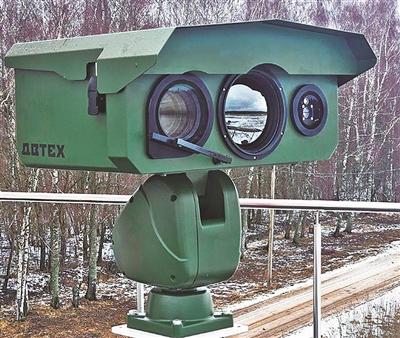
Radar-optical system developed on the basis of the Loris radar.
Conventional radars have inherent limitations in detecting low-altitude, slow-speed and small targets, characterized by "seeing high but not low, seeing far but not near", which makes them ineffective against such threats. To address this challenge, Russian engineers have attempted to equip radars with "optical eyes".
According to Russian media reports, based on the mature compact Loris radar, Russian technical personnel have developed a brand-new radar-optical system. The original Loris radar was only capable of detecting and tracking slow-speed targets, while the new system can not only detect and track targets, but also accurately identify target types, assess threat levels and automatically issue alerts to operators. Its identification capability significantly reduces the false alarm rate and effectively avoids misclassifying interference sources such as bird flocks as threatening targets. At present, the new radar system is undergoing range trials.
Analysts believe that the performance improvement of the new radar system stems from the integration of the Loris radar with a long-range electro-optical observation system. The Loris radar acts as a "scout", specializing in detecting low, slow and small targets with speeds below 200 km/h, covering the speed range of most small unmanned aerial vehicles. The electro-optical system serves as an "identifier", adopting dual-channel design of visible light and infrared. It automatically locks onto targets guided by the radar and uses advanced neural network algorithms to accurately identify target categories (personnel, vehicles, birds or UAVs), even specific equipment models. It effectively filters out false signals such as bird flocks and cloud clusters, evaluates threat levels and generates alarm signals. The combination of the two greatly simplifies the operator’s workflow and reduces the risk of human error.
Military experts point out that after target detection, the key lies in close coordination with fire support to ensure rapid destruction as targets approach. To this end, the radar system needs to achieve maximum effectiveness through large-scale deployment. For example, it can be miniaturized and mounted on UAVs to perform precision strike missions; or integrated with automatic artillery, machine guns or missiles to form an integrated "reconnaissance-control-strike" loop, with the radar continuously tracking targets and weapons automatically engaging under radar guidance. In the future, the radar system will be installed on maneuver platforms such as armored vehicles, enabling troops to rapidly respond to drone swarm attacks.
The new radar system is not Russia’s only solution to counter drone swarm threats. Russian media previously reported on another compact short-range low-altitude surveillance radar developed by Russia. This radar can detect medium-sized UAVs within a range of 7.5 kilometers. Lightweight and compact, it can be flexibly deployed on masts, buildings or various mobile chassis, including ordinary vehicles and all-terrain vehicles. An airspace surveillance system built with multiple such radars has already entered service.
By Zhang Xinyu
Source: China National Defense News, 2025-07-22 17:19:59
Editor: Lv Zhongshi